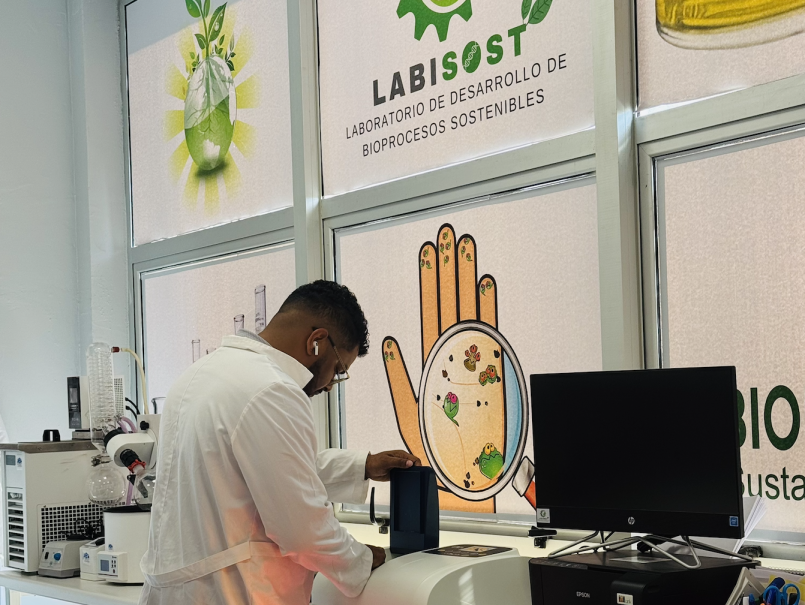


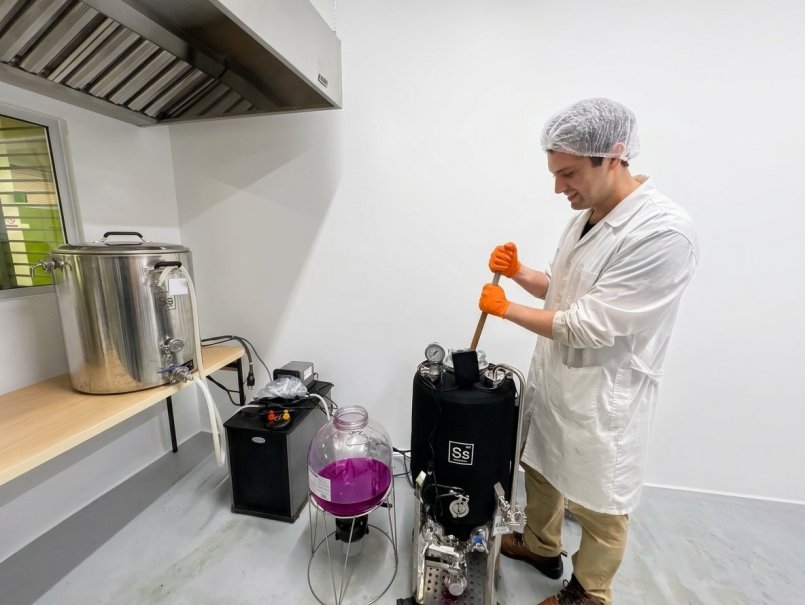
An innovating practical learning space is being developed by the School of Biochemical Engineering through a micro-winemaking workshop, which allows students to work directly in winemaking processes using a plant that was originally designed for beer production.
The initiative emerges as a natural evolution of the use of these facilities, incorporating new applications in the winemaking field. This was explained by scholar María Cristina Schiappacasse, who highlighted the fact that “we are working with a plant that was originally thought for beer production, with fermenters acquired from local vendors and a more recent line of stainless steel brought from the United States, which allows us to work with different processes”.
Along the same line, she stated that the transition towards micro-winemaking came to fruition just recently. “This semester, for the first time, we adapted the plant for wine production, within the framework of an elective course. We are creating a red wine from merlot grapes coming from Casablanca, grown organically, which allows us to plan for a product of very high quality”, the professor indicated. She teaches classes together with the scholar of the same school, Paola Porrier.
David Jeison, also a professor at the School of Biochemical Engineering, was the responsible for implementing the beer plant with national machines and others acquired in the United States.
“The production of beer and wine is based on fermentation processes, a fundamental field in the training and work of biochemical engineers. In this context, the implementation of a beer pilot plant represents a valuable formative tool that will allow students, through elective courses, to connect theoretical knowledge with practical experiences. In this way, their understanding of applied biotechnological processes is strengthened as well as their approach to relevant productive activities”, Jeison explained.
The experience has been well received by students. “Students are highly motivated when they can apply their knowledge to a real process, which strengthens their training and brings them close to the working world”, María Cristina Schiappacasse added, highlighting the contribution of this initiative to the approach to the winemaking industry.
Students
From the perspective of students, Ignacio Morales, sixth year student of the program, valued the impact of these types of experiences. “We are developing a process of micro-winemaking with a merlot wine, and currently, we are in the alcoholic fermentation phase. It has been a very gratifying experience because much of these knowledge we learned theoretically and today we can apply it into our practice”, he mentioned.
In the same way he highlighted the contribution of the available facilities. “This plant is an amazing resource, since it allows us to come closer to real processes and be better prepared for our professional practicums, improving our technical knowledge and the ability to develop in productive environments”, he noted.
For her part, Catalina Miranda, teacher assistant, underscored the formative nature of the experience. “It has been a challenge, since it is the first time this course is taught, but apply the knowledge of the program into practice, especially in processes such as fermentation, has been very enriching”, she said, adding that this type of opportunities “also prepare me to better face the working world”.
The micro-winemaking workshop is aligned with the PUCV Educational Model, which promotes learning that is active, student-centered and connected to real experiences. This approach seeks to integrate theory and practice, incorporating the use of technologies and methodologies that will favor autonomy and the development of professional competences in tangible contexts.
The implementation of this workshop consolidates a training line applied at the PUCV, where theory is articulated with practice, allowing future professionals to be better prepared to face the challenges of the industry, in relevant areas such as food and drink production at the national and international level.
By Sebastián Paredes
Strategic Communication Department