

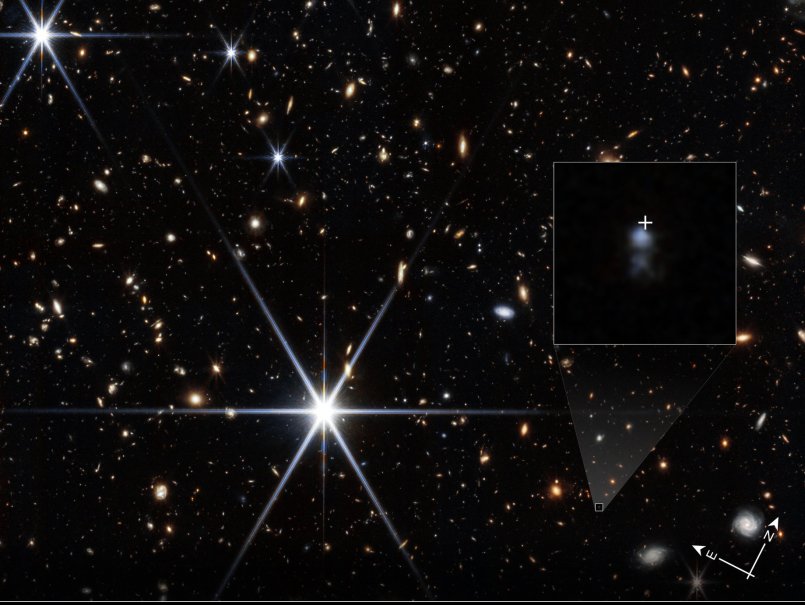
Image: NASA, ESA, CSA, STScI, Manisha Caleb (SIfA); Processing: Joseph DePasquale (STScI)
Through a collaborative effort that combined spatial technology and state of the art telescopes, scientists at our University joined an international study that was able to identify the farthest Fast Radio Burst ever recorded, which was broadcast when the universe was only 3,000 million years old. This finding, published in the journal Science, places the institution from the Valparaiso Region at the cutting-edge of global astrophysics and frontier science.
Fast Radio Bursts are one of the most fascinating astronomy enigmas of our time. They are intense electromagnetic pulses that release in a fraction of time - smaller than a millisecond- an amount of energy equal to that of the Sun during three days or even a few weeks. They were discovered in 2007 and have been the subject of systematic searches since 2017, most of them located in galaxies of the close universe. However, this recent investigation showed that this phenomenon also happened in the childhood of the cosmos, in primitive, young and less massive galaxies.
The role of the PUCV was key to making sense of this phenomenon. After the initial capture of the pulse by radiotelescope MeerKAT in South Africa through the MeerTRAP project, the PUCV team - headed by Nicolás Tejos, scholar at the Physics Institute, and post-doctoral researcher Ilya Khrykin - led the optical follow up to the galaxy of origin together with collaborators in the United States.
James Webb Spatial Telescope
Due to the impossibility of observing the galaxy with terrestrial telescopes because of their extreme tenuity, the team used the James Webb spatial telescope. Thanks to its capabilities within the infrared spectrum, the dim host galaxy was identified and its distance calculated with precision through its redshift.
“This research is about the study of fast radio bursts, which are pulses on radio waves that come from other galaxies and that we identify from Earth. In less than ten years of systematic FRB’s search, we have come to the point that this article represents, which is a field milestone, corresponding to the FBR detected at the greatest cosmological distance. The universe is approximately 14,000 million years old according to our Big Bang theory, and this pulse comes from when the universe was only 3,000 million years old, a different environment where there was more star formation and galaxies were smaller”, Nicolás Tejos explained.
The PUCV Physics Institute scholar added that this discovery contributes fundamental proof to one of the more solid theories about the nature of these events. “The most important repercussion lies on the time scale of the phenomenon, since the emission mechanism continues to be a mystery after almost 20 years of its discovery. One of the main theories proposes they could be magnetars, extremely magnetized neutron stars; our finding provides additional support to this hypothesis”, Tejos added.
Mapping invisible matter and project institutional science
Beyond understanding the origin of the pulses, the study of these phenomena has tremendous significance for cosmology. When traveling through intergalactic space, radio waves interact with free electrons distributed on the “cosmic spider web”. This interaction allows the use of fast radio bursts as measuring tools to track 90% of normal matter (that corresponds to the periodic table of elements) of the universe that is not concentrated in stars nor galaxies, and that is practically impossible to detect by traditional means.
Regarding the impact of developing this fundamental research from the region, Tejos emphasized that “at the PUCV we have all the intellectual and technical abilities to achieve these findings. In astronomy and astrophysics, Chile has a clear advantage by using state of the art instruments at the global level. This allows us to address frontier problems, such as understanding the origin of these pulses and use them to study the intergalactic environment”.
This strategic and internationally excellent participation is not an isolated event, but it dialogues directly with the pillars of the university. The PUCV’s contribution in this scientific milestone reflects what was expressed in its 2023-2029 Institutional Strategic Development Plan.
In particular, it agrees explicitly with the guideline that propels it to lead the frontier research and foster the awarding of projects of great magnitude and international collaboration, as well as joining international investigations, strengthening its position within first level scientific networks in the world and reasserting its vocation to generate relevant knowledge from Valparaíso for the nation and the world.
By Erika Schubert
Strategic Communications Department