

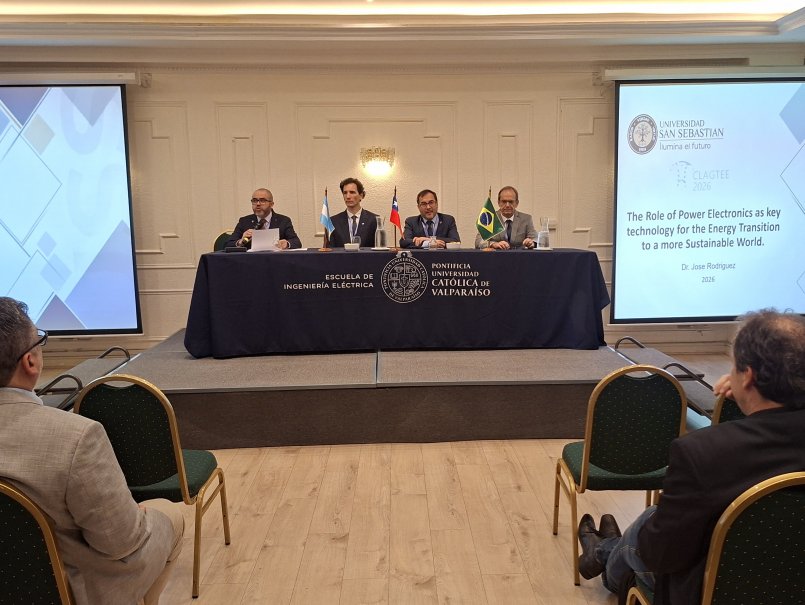
The incorporation of renewable energies and new technologies is transforming electrical systems and poses important challenges for the industry: to optimize the generation and transmission of electricity, anticipate failures and guarantee the continuity of the supply. These were some of the main topics addressed at the 16th Latin American Congress of Generation and Transportation of Electric Energy (CLAGTEE 2026, for its name in Spanish), held in Santiago, and hosted by our university.
The encounter was organized by the School of Electrical Engineering, together with the Universidad Estatal Paulista (Brazil) and the Universidad Nacional de Mar del Plata (Argentina). With a trajectory of more than three decades, this congress has been consolidated as a space of collaboration between universities and industry representatives, oriented towards sharing scientific advances and analyzing challenges of the energetic sector in Latin America.
The program included presentations and debates about integration of renewable energies, the modernization of electric networks, applications of artificial intelligence, electrical markets and development of electrical drive systems for heavy-load vehicles, among other topics.
Vicerrector of Development, Jorge Mendoza, highlighted the importance of the PUCV participating in the organization of this international encounter, considering the transformations happening in the energetic sector and the opportunities that they represent to the training of new professionals.
“Our country faces major challenges regarding how we advance the transition of our energy matrix—a process already underway, primarily through the integration of renewable energy sources. Undoubtedly, the path ahead will be heavily shaped by the adoption of new technologies,” he noted.
He also highlighted the contribution of university research to industrial and economic development, stating: “This is a practical initiative aimed at being integrated into both national and international production processes.”
He added that conferences like CLAGTEE serve as “a gateway for our undergraduate and postgraduate students, as they bring together many of the academics tasked with training the next generation, alongside the new technologies currently being implemented.”
Meanwhile, Ariel Leiva, Director of the School of Electrical Engineering, underscored the academic and scientific significance of the event, which provides a forum to address the challenges faced by electrical systems amidst a period of profound transformation. “The sustained growth in energy demand—driven by electromobility, data centers, and the development of new technologies—coupled with the increasing integration of renewable energy sources like solar and wind, presents significant challenges for the generation, transmission, distribution, and storage of electrical energy,” he stated.
He further noted that a large portion of daily activities would cease to function without a supply of electrical energy. “Our dependence on electricity is virtually total—from communications and transportation to healthcare services, industry, and the very functioning of our cities,” he pointed out.
“CLAGTEE represents an opportunity to integrate three fundamental pillars of our university mission: the training of professionals, the generation of knowledge, and engagement with society. Through our school, we contribute to the development of electrical systems that are more efficient, secure, resilient, and sustainable,” the academic concluded.
Professor Justo Roberts, from the National University of Mar del Plata, highlighted the fact that the congress has continued for over 30 years, fostering ongoing collaboration among researchers from various countries in the region.
“It is an honor to uphold such a long-standing tradition. Those who started all this have, naturally, since retired, but we—the new generations—are committed to keeping it going,” he said.
The academic also emphasized the value of in-person attendance for professional development and the exchange of experiences. “Maintaining an in-person format for congresses allows for networking and provides insight into the work being done in other countries,” he noted.
For his part, Celso Eduardo Tuna, from the Universidad Estatal Paulista, highlighted the initiative’s trajectory and its contribution to regional cooperation. He noted that the gathering provides an opportunity to discuss the modernization of electrical systems and practical pathways for advancing the energy transition, incorporating topics such as smart grids, artificial intelligence, and electricity markets.
As a lead-up to CLAGTEE 2026, a workshop and seminar titled “Artificial Intelligence Applied to Electrical Systems” was held on Tuesday, October 27, at the PUCV Santiago campus. The event brought together specialists to analyze the opportunities this technology offers for the generation, transmission, and distribution of electricity.
By Jenny Díaz
Strategic Communications Department